


I Will Fear No Evil
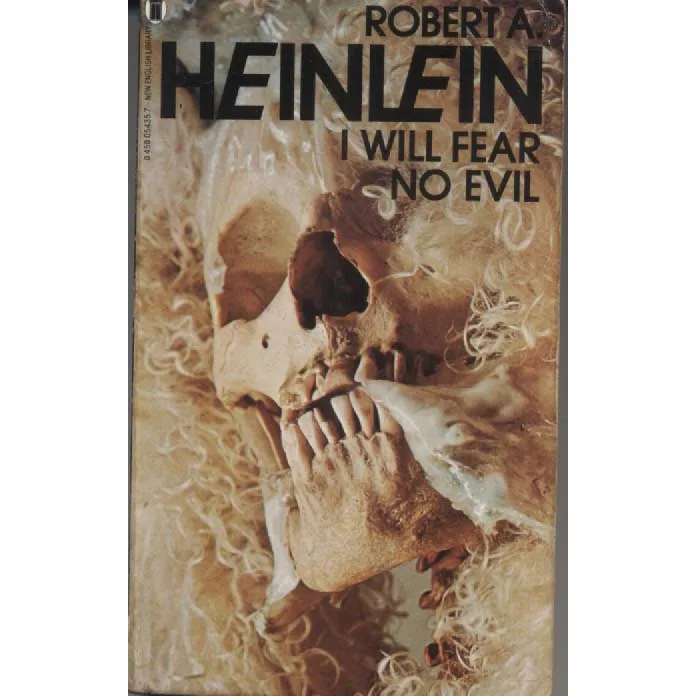
Publisher: New English Library
Format: Paperback
ISBN: 0450054357
I Will Fear No Evil (1981) by Robert A. Heinlein
New English Library | ISBN: 0450054357 | Condition: Good
There are people who fear death, people who attempt to postpone it through exercise, healthy eating and expensive medical advice, and then there are people who possess so much money that they begin to suspect mortality is merely another administrative inconvenience that could be resolved by hiring the appropriate specialists. In I Will Fear No Evil, Robert A. Heinlein introduces us to a fantastically wealthy old man who has accumulated practically everything civilisation can offer except the one commodity he desperately requires: a new body. Unfortunately, acquiring one proves considerably more complicated than purchasing another corporation, particularly when the replacement comes equipped with its own collection of biological characteristics, emotional complications and the lingering possibility that the previous occupant has not entirely vacated the premises.
Originally published in 1970, I Will Fear No Evil is one of Heinlein’s more provocative and unconventional science-fiction novels, exploring questions of identity, consciousness, mortality, sexuality and the extraordinary lengths to which human beings might go to avoid the inconvenience of dying. It belongs to that period of Heinlein’s career when he became increasingly interested in challenging conventional social arrangements, examining the assumptions underlying human behaviour and occasionally demonstrating that a science-fiction novel could contain enough philosophical argument to occupy several university departments for an entire academic year.
At the centre of the story stands Johann Sebastian Bach Smith, an immensely wealthy and thoroughly elderly businessman whose considerable financial achievements have failed to prevent his physical decline. Smith possesses money, influence and access to sophisticated medical technology, but his body has reached the stage where even the finest financial arrangements cannot persuade it to behave satisfactorily.
Fortunately, the future has developed a rather ambitious surgical procedure involving the transplantation of a human brain into another body. For most people, such an operation would present considerable practical difficulties, not least the problem of finding a willing donor and surviving an experimental procedure that makes conventional surgery look like a visit to the dentist. For Smith, however, the matter is approached with the confidence of a businessman accustomed to discovering that almost anything can be arranged if sufficient money is available.
The operation succeeds, after a fashion, and Smith awakens to discover that his brain has been transplanted into the body of Eunice Branca, his beautiful young secretary, whose death has made her physical remains available for this extraordinary medical experiment.
This is where the novel becomes considerably more complicated than a straightforward tale of scientific rejuvenation.
Smith, formerly an elderly gentleman with the attitudes, habits and experiences of a lifetime, must now adjust to inhabiting the body of a young woman. The transformation presents enormous practical, psychological and social challenges, particularly when he discovers that the physical characteristics of his new existence are accompanied by sensations and experiences that his previous life had not adequately prepared him to understand.
One might imagine that possessing an enormous fortune and a youthful body would be sufficient to guarantee happiness. Heinlein, naturally, has other ideas.
The situation becomes stranger still when Smith begins experiencing the apparent presence of Eunice’s personality within his consciousness. Rather than disappearing entirely, the young woman seems to survive as an internal companion, offering advice, opinions and a running commentary upon the extraordinary circumstances in which they now find themselves.
This creates the rather unusual spectacle of two personalities attempting to negotiate the practical arrangements of occupying a single human body, an experience that makes the conventional difficulties of sharing a house, office or motor car appear comparatively straightforward.
For readers accustomed to science fiction involving spaceships, alien invasions and heroic battles against terrifying extraterrestrial creatures, this may seem an unexpected direction. Heinlein instead turns the human body itself into the setting for an elaborate investigation of personal identity, asking what makes an individual who they are and whether consciousness can remain fundamentally unchanged when the physical circumstances of existence are transformed.
Is a person defined by memory, personality, biology, social experience or some complicated combination of all four? Does the continuation of consciousness guarantee the survival of the original individual? And what happens when the identity of the body conflicts with the accumulated experiences of the mind inhabiting it?
These are serious philosophical questions, although Heinlein approaches them with his customary enthusiasm for unconventional relationships, provocative dialogue and situations calculated to alarm readers possessing firmly established opinions about proper social behaviour.
The novel also offers a distinctly Heinleinian examination of gender and sexuality, subjects that become central to Smith’s adjustment to his new circumstances. His transformation forces him to reconsider attitudes and assumptions that had developed during a long life as a wealthy man, while Eunice’s apparent continuing presence complicates the situation further.
Heinlein was never especially inclined to accept conventional morality simply because it was conventional. His later fiction frequently explores alternative relationships, personal freedom and the social restrictions imposed upon individual behaviour, often with the enthusiasm of a man who has identified an entire collection of sacred cows and intends to investigate whether they can be persuaded to move.
Not everyone will find his conclusions persuasive, and some of the novel’s attitudes reflect their period rather than contemporary understandings of gender and identity. Nevertheless, the book remains fascinating as an example of speculative fiction deliberately confronting questions that mainstream literature of its time was often reluctant to examine.
The futuristic society in which the story unfolds provides another characteristic Heinlein setting. Technological progress has produced remarkable medical possibilities, but society itself remains troubled by inequality, corruption, violence and the familiar tendency of human institutions to become increasingly complicated without necessarily becoming more sensible.
Smith’s enormous wealth gives him opportunities unavailable to ordinary citizens, including access to the experimental medical procedure upon which the entire story depends. The contrast between technological achievement and social dysfunction is striking, suggesting that humanity may eventually learn how to transplant brains without making comparable progress in the much simpler business of treating one another reasonably.
This is a recurring theme in Heinlein’s fiction. Scientific knowledge advances, technology transforms everyday life and human beings acquire extraordinary new capabilities, yet jealousy, greed, vanity, ambition and political foolishness continue operating with impressive reliability.
Apparently, even the conquest of death would not necessarily improve the quality of public administration.
There is also something wonderfully ironic about Smith’s original predicament. Having devoted his life to accumulating wealth and exercising power, he discovers that his greatest ambition is simply to continue existing. The corporate empire, financial achievements and professional authority that once defined his identity become comparatively unimportant when confronted with the possibility of mortality.
One suspects that this realisation would be profoundly unsettling for any billionaire who has spent several decades believing that acquiring another company represents a meaningful contribution to human happiness.
Yet Heinlein does not merely present his protagonist as a wealthy eccentric attempting to purchase immortality. Smith’s transformation becomes the starting point for an exploration of affection, intimacy, experience and the meaning of living rather than simply surviving.
A new body provides possibilities that his previous existence had denied him, but it also demands that he reconsider what he actually wants from life. The distinction between continuing to exist and finding existence worthwhile becomes increasingly important, particularly when the circumstances of one’s survival are so extraordinary.
The novel’s internal conversations between Smith and Eunice are among its most distinctive features. Their exchanges provide a vehicle for examining competing attitudes and interpretations, while introducing the intriguing possibility that personal identity may be less individual and self-contained than people generally assume.
Most of us experience occasional internal disagreements, particularly when deciding whether to purchase something expensive, eat another slice of cake or send an ill-advised message after several glasses of wine. Heinlein takes this familiar psychological phenomenon and transforms it into an extraordinary speculative situation in which the competing voices may possess genuinely separate personal histories.
It is difficult enough making important decisions with one personality. Two might reasonably be expected to require a formal committee, an agreed constitution and occasional assistance from an independent mediator.
The story’s treatment of medical technology also has a particularly interesting historical dimension. Writing at the end of the 1960s, Heinlein was exploring possibilities that seemed fantastically remote from the capabilities of contemporary medicine. Organ transplantation was developing rapidly, but the transplantation of a functioning human brain into another body remained far beyond scientific reality.
The novel therefore belongs to a fascinating period of speculative optimism, when advances in surgery, computing and biological science encouraged writers to imagine extraordinary transformations in human existence.
More than half a century later, neuroscience and transplantation medicine have progressed enormously, but the practical obstacles to such a procedure remain formidable. The central premise consequently retains its speculative character, even as modern debates about consciousness, artificial intelligence, biological identity and the extension of human life have made some of its underlying questions increasingly familiar.
There is something particularly entertaining about the idea that wealthy individuals might attempt to extend their lives indefinitely through scientific innovation. Contemporary enthusiasm for longevity research, experimental therapies and elaborate programmes intended to postpone ageing suggests that Smith’s determination to escape mortality was not quite as outlandish as it may once have appeared.
The difference, of course, is that Heinlein’s protagonist pursues a rather more dramatic solution than eating carefully, exercising regularly and submitting to an expensive programme of biological monitoring.
His approach is essentially to acquire a replacement body and hope that everything works out.
One cannot help wondering how such a procedure would be marketed if it ever became commercially available. Presumably there would be an elaborate consultation process, several pages of medical disclaimers and a particularly alarming section explaining that the patient might awaken with an entirely different appearance, unfamiliar biological characteristics and an additional personality offering unsolicited advice.
The optional extended warranty would undoubtedly be expensive.
Heinlein’s novel also reflects his fascination with the relationship between personal freedom and social convention. Smith’s transformation places him in circumstances where established expectations about identity, relationships and behaviour become difficult to apply. The result allows Heinlein to question assumptions that normally pass unnoticed, simply because most people never encounter situations sufficiently extraordinary to expose their contradictions.
That is one of science fiction’s great strengths. By introducing an impossible or highly improbable development, a writer can examine familiar human concerns from an entirely unfamiliar perspective.
A conventional novel about an elderly millionaire confronting mortality might explore regret, ambition and the limitations of wealth. Heinlein transforms the same underlying situation into a speculative adventure involving experimental surgery, consciousness, gender, identity and a degree of intimate complication that would probably exhaust the resources of an ordinary family solicitor.
Naturally, the result is not a modest undertaking.
I Will Fear No Evil is a substantial novel, filled with conversation, philosophical speculation and Heinlein’s unmistakable interest in the finer details of human relationships. Readers seeking the brisk action of his earlier juvenile adventures may find the pace and subject matter rather different from what they expect.
This is Heinlein in his expansive, argumentative and deliberately provocative mode, more interested in examining the implications of his central idea than rushing through a conventional sequence of adventures.
For admirers of Stranger in a Strange Land, Time Enough for Love and his other more philosophically ambitious works, the approach will be familiar. Heinlein’s characters possess an extraordinary capacity for discussing human existence at length, often while navigating circumstances in which a less intellectually enthusiastic individual might simply telephone a doctor and ask whether everything was entirely normal.
The novel is also an interesting example of the changing direction of science fiction during the late 1960s and early 1970s. The genre was moving beyond its traditional emphasis upon technological adventure and planetary exploration, increasingly addressing psychology, sexuality, social organisation and the nature of consciousness.
Heinlein was a central figure in this development, although his particular approach remained unmistakably his own. He combined engineering-minded speculation with libertarian ideas, individualism, humour and an enthusiasm for challenging social restrictions, producing fiction that could be entertaining, controversial and occasionally exasperating within the space of a few pages.
There is also a poignant aspect to the circumstances surrounding the novel’s creation. Heinlein experienced serious health difficulties while working on the book, and the published text appeared without the degree of final revision he would ordinarily have undertaken. This provides useful context for readers encountering a work that is sometimes regarded as less tightly constructed than his most celebrated novels.
Nevertheless, the central imaginative proposition remains extraordinarily memorable. The desire to escape death is one of humanity’s oldest preoccupations, appearing in mythology, religion, philosophy and literature throughout recorded history. Heinlein simply approaches the matter through the technological possibilities of speculative fiction, asking what might happen if someone possessed sufficient wealth and determination to attempt a practical solution.
The resulting complications suggest that immortality may not be quite the straightforward advantage that its more enthusiastic advocates imagine.
After all, extending one’s life is one thing. Determining whose life one is actually living afterwards is quite another.
This 1981 New English Library edition offers readers an opportunity to revisit one of Heinlein’s more unusual and ambitious novels, from a period when science-fiction paperbacks regularly combined imaginative covers, challenging ideas and subject matter that could produce considerable embarrassment if left open on the wrong page during a family gathering.
It is also a reminder of the extraordinary range of Heinlein’s career. The author who wrote memorable adventures about space travel, lunar colonies and youthful explorers was equally willing to investigate philosophical problems concerning human consciousness and identity, even when the resulting fiction ventured into decidedly unconventional territory.
For collectors of classic science fiction, I Will Fear No Evil occupies an important place in the development of Heinlein’s later work. It demonstrates his determination to pursue provocative ideas without excessive concern for whether readers would find them comfortable, conventional or particularly appropriate for polite discussion over Sunday lunch.
The book also presents an intriguing historical perspective on changing attitudes towards medicine, sexuality and the future of human biology. Some of its ideas remain challenging, others have aged less comfortably, and its assumptions occasionally reveal as much about the period in which it was written as about the imaginary future it describes.
But that is part of the attraction of vintage science fiction. Such books do not merely predict imaginary futures; they preserve the hopes, anxieties and intellectual preoccupations of the societies that produced them.
This 1981 New English Library edition is offered in Good condition by Crappy Old Books, a bookseller that appreciates the pleasures of elderly science-fiction paperbacks and recognises that a book can acquire character through age without requiring anything as drastic as a complete biological transplant.
Unlike Johann Sebastian Bach Smith, this volume has retained its original identity without having to negotiate the acquisition of an entirely different physical form. It may possess the modest signs of age expected of a second-hand paperback, but it continues to function perfectly adequately without experimental surgery, specialist medical supervision or the financial resources of an international industrial empire.
An excellent addition to any collection of Robert A. Heinlein, classic American science fiction, speculative literature or novels exploring consciousness and personal identity, I Will Fear No Evil will appeal particularly to readers interested in the author’s more provocative and philosophically adventurous work.
It would also make a suitable gift for anyone fascinated by the prospect of radical life extension, provided they understand that the book is a work of fiction rather than a practical medical handbook. The procedures described should not be attempted at home, even by individuals possessing an exceptionally well-equipped garage and a rather optimistic understanding of modern surgery.
A bold, provocative and unmistakably Heinleinian exploration of mortality, identity, sexuality and the extraordinary complications that arise when an elderly millionaire attempts to escape death by acquiring a younger body.
And perhaps the greatest irony of the entire enterprise is that a man who has spent his life accumulating enormous wealth eventually discovers that money can buy almost everything except a straightforward answer to the question of who he actually is.
Crappy Old Books: preserving the classics of speculative fiction one second-hand paperback at a time, without requiring experimental surgery, a billionaire’s bank account or the consent of an unusually accommodating brain donor.
And should anyone suggest that ageing is simply a matter of attitude, you may confidently inform them that Robert Heinlein investigated a somewhat more ambitious solution.
Admittedly, the results involved considerable confusion, complicated relationships and a quantity of philosophical discussion that might discourage even the most determined enthusiast for eternal youth.
Perhaps it would be simpler to accept the passing years, enjoy a good book and spend the money saved on something rather less medically adventurous.
After all, growing old may be inconvenient, but at least you generally know whose trousers you are wearing.
Keep browsing: See more Science-Fiction books Other books by Robert A Heinlein
